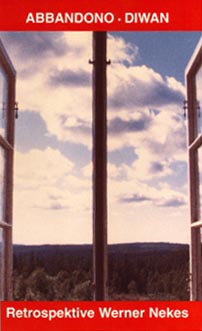
Retrospektive Werner Nekes
Abbandono & Diwan
Abbandono
1970,16 mm, color, 35 min.
“Abbandono (1966-1970) is composed of material from four year's work. Maybe this is the reason why the film is one of Werner Nekes' most expressive and most replete with imagery. 'For and with Dore 0.' - the quality of the pictures is more lyrical and more vivid than usual. Their composition however typically corresponds to his other films in the manner in which they recur. We see Dore running in a snowscape, dissolving into white, a view of red shingled roofs, falling snow; a corridor of passage, filmed in green monochrome and in such a way that the objects defining it are visible only in parts. Dore walks down this corridor and Werner sometimes too. The sound is among the best that Anthony Moore has created; a sequence of gently undulating, poignant tones that rise to a sharply sounding crescendo and then die away." (Tony Reif, Vancouver Cin6math6que, Canada 1972).
"...Nekes retreats behind his film. What is left is a double portrait, in which neither Dore 0. nor the grand landscape remain unchanged. The cold of the icy coastline - long shots of stones, snow and the sea - dwindles away before the image of Dore 0. Solitude is superflous, when the grandiose mountain meadow invites somersaults.
... In this case Nekes handles what he shows considerately. He releases the objects he portrays. He allows them to unfold. And so model and patterns actually serve another purpose: to let poetry grow, and energy and beauty and confidence nell'abbandono." (Dietrich Kuhlbrodt, Filmkritik, 9/1971).
Diwan
Diwan (Part 5: Hynningen)
1973,16 mm, color, 85 min.
Sound: Anthony Moore
Cast: Ludi Armbruster, Nikolaus Hof, Rosmarie Liesen, Peter Könitz, Reinhild Lüders, Wolfgang Liesen, Geeske Hof-Helmers, Werner Nekes, Dore 0., Christian d'Orville, Ursula Winzentsen, Franz Winzentsen, Bernd Hof, Klaus Wyborny.
A film anthology in five installments: 1. sun-a-mul (16 min) 2. alternatim (15 min) 3. kantilene (17 min) 4. moto (16 min) 5. hynningen (21 min). The fifth installment, "hynningen" was awarded the Bundesfilmpreis in Silber in 1975.
"Hynningen (Swedish for 'honey roof') begins with long multiple exposures of a landscape with a clearing, opening up to the horizon. In the middle of the clearing there is a simple log cabin of the type characteristic of Northern Europe or Quebec. There are actors a man and a woman - at the window, at the doorway, strolling in the grass, doubled or even tripled by multiple exposure. Traces they have left at different moments of the day and in the changing light appear as gentle phantoms. If our varying perceptions would outlast changes in location we would experience a strong sense of continuity and of repetition. This visual counterpart to the imperfect tense in grammar is amplified by three high tones on a background of sinus curves. These gradually reach a higher pitch. But this isolated house, filmed in the almost silent density of a Baudelarian 'Afternoon without end', that seems as if made to accommodate peace and meditation, does it not attain a sudden, bewildering presence? If it is true that the term 'to be' originally means 'to live' and 'to unfold' but also 'to dwell', taking into account both Indo-European roots (es, bhû) as well as the Germanic ‘wes', is one not, on seeing this dwelling place, invariably reminded of what Heidegger said about Man as 'the keeper of his being'? Is this honey roof not the place of sheltered existence? No matter what Nekes himself thinks about his films and no matter how dominant the primacy of technique and structure, has he not with DIWAN begun erecting a metaphysical oeuvre, in which unto the cinema is bestowed the task of concealing and revealing existence as such? This is precisely the purpose that according to Heidegger constitutes Man's oppressive privilege, Man who is subjected to the painful experience of boredom and of Angst. The end of the film is as cheerful as it is mysterious: we are led into the house with the honey roof. In front of a window, open as in the paintings of Magritte, the inhabitants walk, in multiple exposure, naked and silent..."(L'Art Vivant, Paris, Oct. 1974).
 |